MACKINAC ISLAND, MICHIGAN
by Suzy Miller, September 19, 2026
OVERVIEW
Mackinac Island sits in Lake Huron at the eastern end of the Straits of Mackinac, between Michigan’s Upper and Lower peninsulas.
Ferries connect the island with Mackinaw City, near I-75 in the Lower Peninsula, and St. Ignace, near U.S. Highway 2 in the Upper Peninsula. It's in Mackinac County, and the entire island is listed as a National Historic Landmark.
The island is about 3.8 miles long and 2.5 miles wide at its broadest points and covers roughly 2,780 acres. Its shoreline is approximately eight miles around.
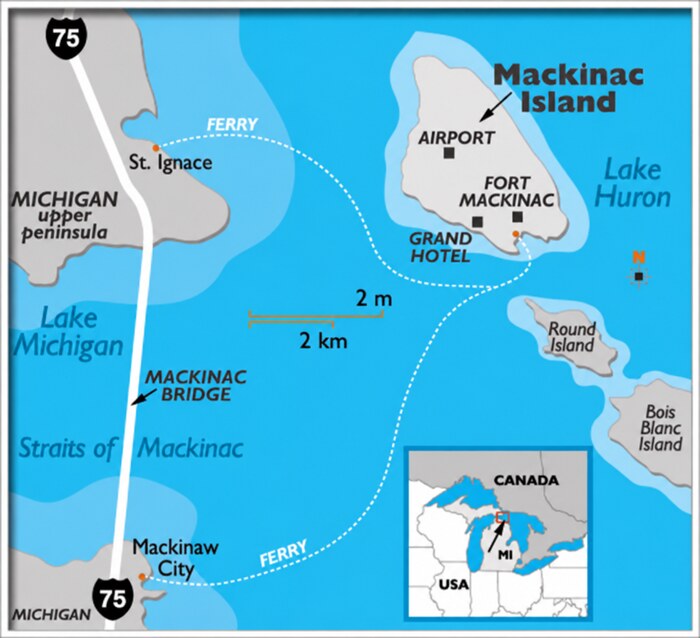 Map showing Mackinac Island's location in Lake Huron
Mackinac Island has a year-round population of almost 600 residents, although thousands of visitors arrive during the summer. It's known for its historic buildings, horse-drawn carriages and dramatic shoreline.
The island combines history and outdoor recreation with an old-fashioned resort atmosphere. More than 80 percent of Mackinac Island is protected within Mackinac Island State Park.
One of the island’s most distinctive features is the absence of ordinary automobile traffic. Visitors primarily get around on foot, bicycle or by horse-drawn transportation.
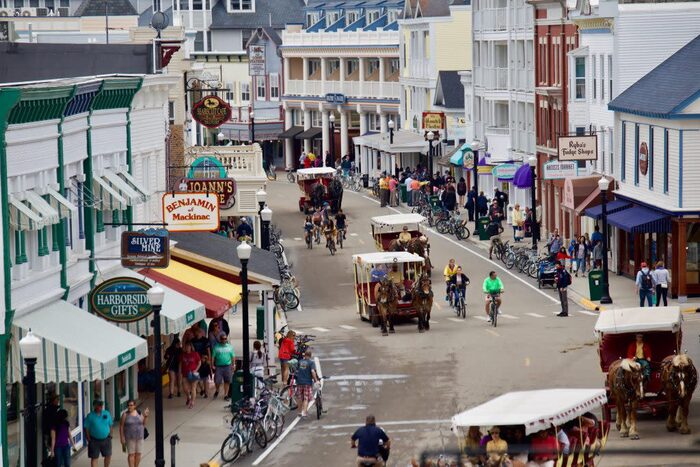 Mackinac Island Main Street in summer
HISTORY AND BACKGROUND
Native peoples have lived around the Straits of Mackinac for thousands of years. Anishinaabe people, including Ojibwe, Odawa and Potawatomi communities, were established in the region before Europeans arrived.
French missionaries, explorers and fur traders reached the Straits during the 1600s. The area became an important center of the Great Lakes fur trade.
The island’s name comes from the Anishinaabe term Michilimackinac, “Great Turtle,” inspired by the island’s shape.
During the American Revolution, the British moved their military post from mainland Fort Michilimackinac to Mackinac Island, constructing Fort Mackinac beginning in 1780.
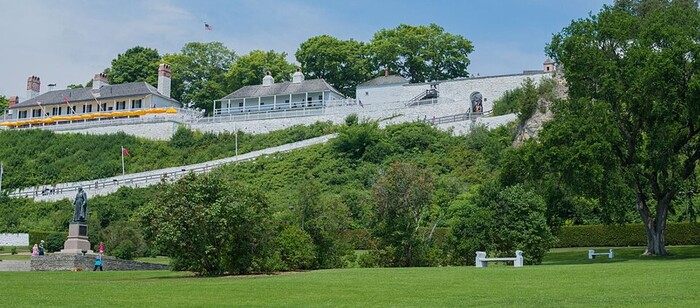 Fort Mackinac on Mackinac Island
courtesy of N8huckins on Wikipedia
The United States took possession of the fort in 1796, but British forces captured it during the War of 1812. It returned to American control following the war and remained an active military post until 1895.
Mackinac Island became a popular summer destination during the 19th century. In 1875, much of the island became Mackinac National Park, the nation’s second national park.
When the federal park closed in 1895, the land became Mackinac Island State Park, Michigan’s first state park.
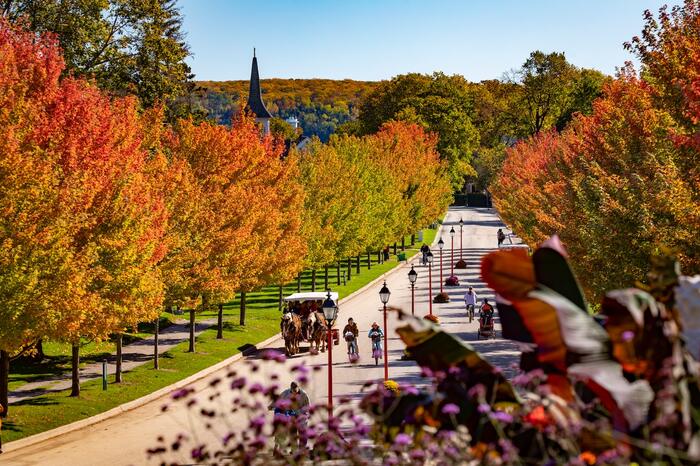 A horse-drawn carriage on Mackinac Island in autumn
Courtesy of Mackinac Island Tourism Bureau
Automobiles began appearing on the island in the late 1890s, and their engines frightened the horses that provided most local transportation.
Carriage operators were concerned about runaway horses, accidents and the effect automobiles could have on their livelihood. They petitioned village officials to prohibit the new “horseless carriages.”
The village banned automobiles on July 6, 1898, and Mackinac Island State Park followed in 1901. What began largely as a practical safety and transportation measure eventually became one of Mackinac Island’s best-known traditions.
WHAT YOU'LL SEE AND DO
Mackinac Island has one incorporated municipality: the city of Mackinac Island, which encompasses the entire island.
The Island is known for its remarkably well-preserved 19th- and early-20th-century architecture. Downtown includes older commercial buildings and homes, while the East and West bluffs have elaborate summer cottages built during the island’s Victorian resort boom.
Styles include Greek Revival, Queen Anne, Stick, Shingle, Colonial Revival and Tudor Revival. Many homes feature decorative woodwork, towers, broad porches and large windows designed to catch Lake Huron breezes.
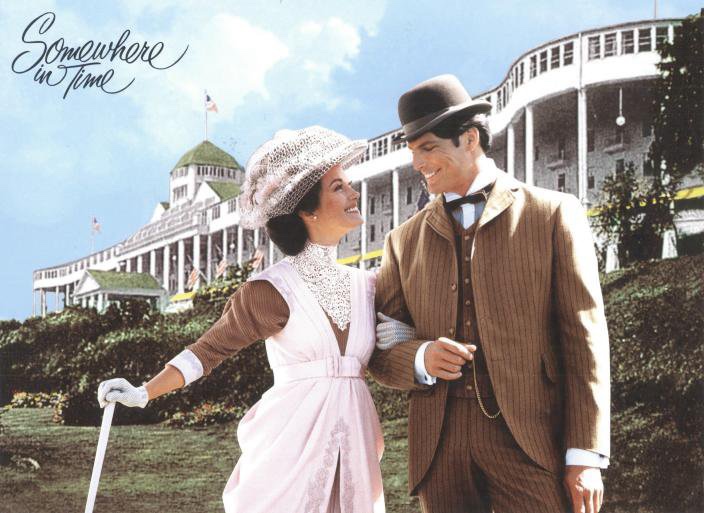 Somewhere in Time movie still with Grand Hotel in background
The Grand Hotel, built in 1887, is the island’s most famous architectural landmark. The 1980 film Somewhere in Time, starring Jane Seymour and Christopher Reeve, was filmed on the island.
It highlights various landmarks on the island including the Grand Hotel. Every year there is a "Somewhere in Time" weekend, and Jane Seymour has occasionally attended.
The state owns a summer residence built in 1902 for the current governor's use. Historic cottages help give Mackinac Island the appearance of a surviving Victorian-era resort community, not a reproduction of one.
Fort Mackinac is a major attraction, with 14 restored historic buildings, exhibits and interpretive programs.
Other historic sites include the Biddle House and Mackinac Island Native American Museum, the Little Stone Church, Benjamin Blacksmith Shop, American Fur Co. Store and Dr. Beaumont Museum, McGulpin House and the Richard & Jane Manoogian Mackinac Art Museum.
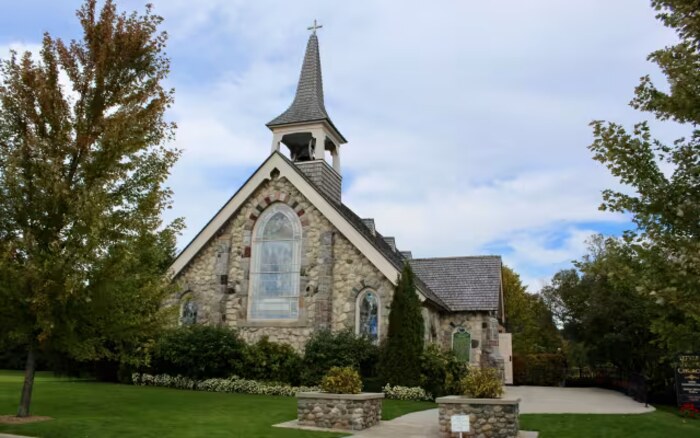 Little Stone Church, built 1904, on Mackinac Island
photo from their website
Downtown Mackinac Island has fudge shops, galleries, boutiques, souvenir stores and restaurants. Horses remain a noticeable part of everyday life.
Visitors can take large sightseeing carriages, private carriage tours or horse-drawn taxis, and some hotels use horse-drawn shuttles.
Horse-drawn drays perform many of the jobs handled by delivery trucks elsewhere, hauling freight, food, packages and supplies.
Visitors can even rent certain horse-and-buggy conveyances to drive themselves after receiving instruction. Saddle horses are also available.
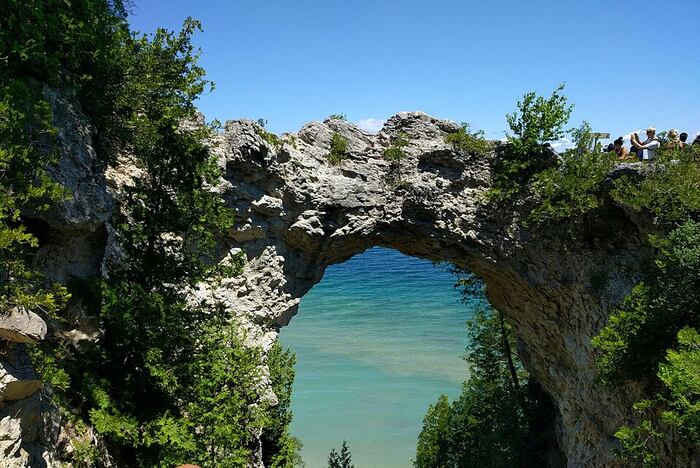 Arch Rock on Mackinac Island
Photo courtesy of Viplav Valluri on Wikimedia Commons
Outdoor highlights include Arch Rock, Sugar Loaf, British Landing and Fort Holmes, the highest point on the island.
Visitors can hike or bike more than 70 miles of trails or follow M-185 around the shoreline. The 8.2-mile route has beautiful Lake Huron scenery and views toward the Mackinac Bridge.
The historic 9-hole Wawashkamo Golf Club, laid out in 1898 in a Scottish links-style, is Michigan's oldest continuously played golf course.
VISITING INFORMATION
Mackinac Island Tourism Bureau
7274 Main Street
Mackinac Island, MI 49757
Telephone: (906) 847-3783
Official website: www.mackinacisland.org
Mackinac Island is accessible by boat or private aircraft. Most visitors arrive by ferry from Mackinaw City or St. Ignace. Ferry trips take about 15 to 25 minutes, depending on the departure point and service.
Once on the island, bicycles are widely available for rent, while horse-drawn carriages and taxis provide another way to travel.
Although more than 80 percent of Mackinac Island is state parkland, there are no campgrounds on the island and overnight camping is prohibited. Visitors who stay overnight must use one of the island's hotels, inns, B&Bs or other accommodations.
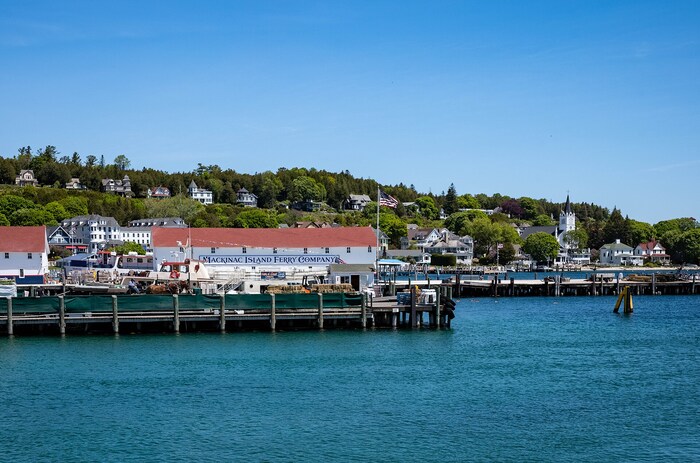 Mackinac Island Docks
Picture courtesy of Юрий Д.К. on Wikimedia Commons
With its preserved historic sites, car-free streets, working horse-drawn transportation system, wooded trails and sweeping Great Lakes scenery, Mackinac Island is an experience unlike anywhere else in Michigan.
Its location at the Straits of Mackinac makes it a natural addition to a Michigan Upper Peninsula itinerary.

We send out a free newsletter now and then to keep you up to date on our website. Just put in your email and check the boxes below.
By Mike Miller, Copyright 2020-2026 YooperSecrets.com