- Home
- Attractions
- Grand Island National Recreation Area
GRAND ISLAND
NATIONAL RECREATION AREA
by Suzy Miller, September 4, 2026
OVERVIEW
Grand Island National Recreation Area (GINRA) is a rugged Lake Superior island just a half-mile off the coast of Munising in Michigan’s Upper Peninsula. The island is part of Hiawatha National Forest and covers about 13,000 acres.
It stretches about eight miles north to south and is about three miles wide. Visitors come to see its sandstone cliffs, forests, beaches, sea caves, arches, inland lakes, lighthouses, historic sites and wildlife.
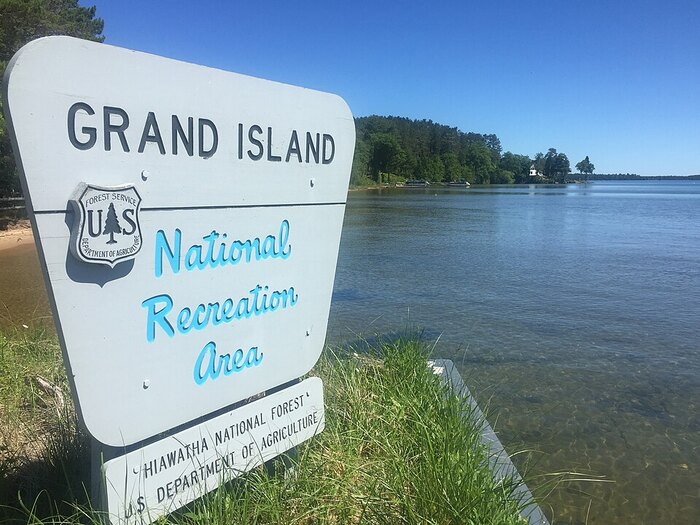 Grand Island Welcome Sign on Lake Superior
HISTORY AND BACKGROUND
There is archaeological evidence showing human occupation dating to about 2,000 B.C. The Ojibwe (Anishinaabe) people used the island and surrounding waters for fishing, hunting and gathering.
European and American traders and missionaries began visiting during the 18th century, and archaeological sites preserve evidence of Indigenous and Euro-American life.
Geologically, Grand Island is closely related to nearby Pictured Rocks. Ancient sandstone formations were shaped by glaciers, waves, groundwater and weathering into today's cliffs, beaches and rocky shoreline.
The fur trade was an important part of Grand Island’s early Euro-American history. The American Fur Company operated a post on the island in the early 1800s, where furs were exchanged for manufactured goods.
Abraham Williams arrived with his family in 1840, took over buildings formerly used by the company and established a trading post of his own. That is the site of Williams Landing. Settlers and fishermen later lived on the island.
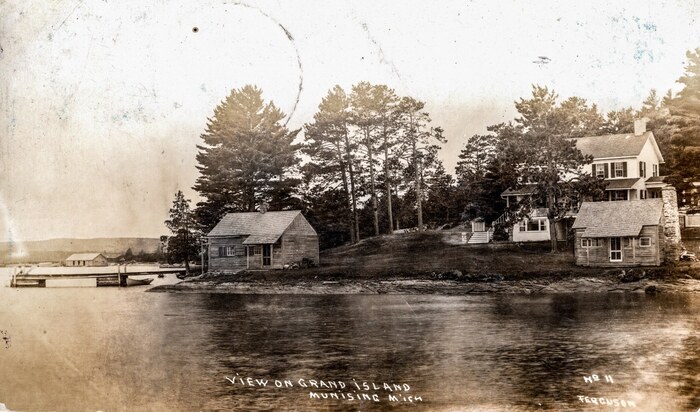 Williams Landing (Astor Fur Trading Post) circa 1940s
Stone Quarry Cottage on Murray Bay, dating to about 1846, is among its oldest surviving buildings. The actual circa-1830 Grand Island fur-trading cabin still exists at the Michigan State University Museum.
Early settlers operated a sawmill and supplied wood to passing steamships. During Prohibition, smugglers hid liquor in the caves on the north side of the island.
Although the Cleveland-Cliffs iron-mining company owned the island for decades, iron ore was not extensively mined there. Sandstone was quarried for construction of the Schoolcraft blast furnace near Munising.
Large-scale logging occurred after Cleveland-Cliffs president William G. Mather died in 1951. His lodge for exotic game hunting still stands on the west side of the island, though the venture itself failed. The exotic animals couldn't take the weather!
Congress established the Grand Island National Recreation Area on May 17, 1990, protecting its scenery, wildlife, vegetation, recreation opportunities, historical and cultural resources, cliffs, caves, beaches and early-settlement features.
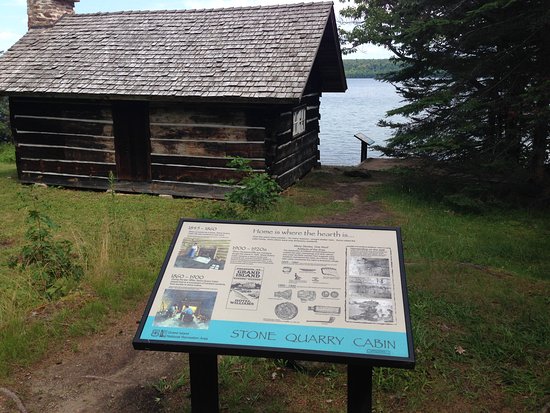 Stone Quarry Cottage on Murray Bay, Grand Island
WHAT YOU'LL SEE AND DO
Grand Island doesn't have paved roads or vehicles except for a tour bus. Hiking, mountain biking, and the tour bus are the most popular ways to explore.
About 40 miles of trails and old roads pass through forests of maple, beech, birch, hemlock and white and red pine, leading to beaches, overlooks, campsites and historic sites.
The 21-mile Perimeter Trail has stunning views of sandy beaches, forested headlands, sandstone cliffs, Pictured Rocks in the distance, and passing freighters. There are hiker-only trails if you want to avoid bicycles.
Visitors can also camp, fish, kayak and watch wildlife. Some campsites have cabins, some have potable water, and food storage poles. Black bears inhabit the island, so visitors should follow Forest Service food-storage precautions. There are a few campsites perfectly situated for kayakers.
Echo Lake, the island’s largest inland lake, has bass, panfish, and pike. Murray Bay is known for its sand beaches and perch, pike, walleye, and rock bass. Trout Bay has sand beaches, lake trout and coho salmon.
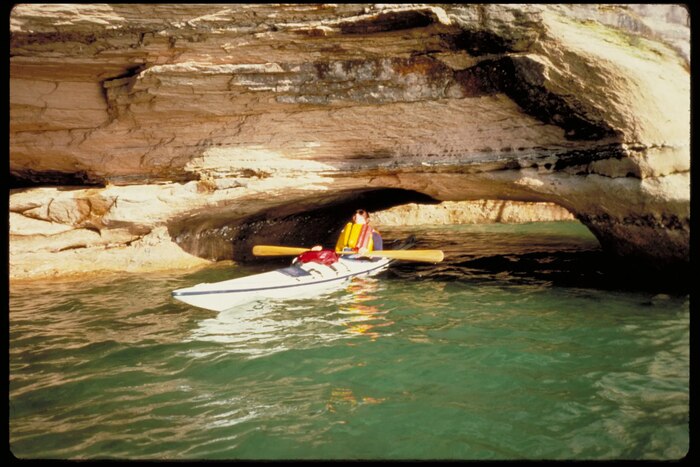 A kayaker at Grand Island National Recreation Area
Grand Island has two historic lighthouses out of Hiawatha’s six total: the picturesque East Channel Lighthouse along the southeastern shore and the Old North Light at North Point.
The Old North Light is on private property but its exterior is still visible from Superior. It's the highest lighthouse above sea level in the USA.
The northern and western cliffs reach about 300 feet above Lake Superior. Photographers can capture shots of beaches, forests, lake views and wildflowers.
Grand Island's cliff faces, sea caves and rock formations are best viewed from a boat or kayak. They say if you haven't kayaked Grand Island, you haven't kayaked!
There are boat tours available from the mainland if you don't kayak. Glass Bottom Shipwreck Tours in Munising pass by Grand Island landmarks like the East Channel Lighthouse.
In the winter some brave souls cross Lake Superior’s frozen surface on snowmobiles, cross-country skis or snowshoes to visit the Grand Island Ice caves. At their own risk, of course, as you can never guarantee Lake Superior is frozen through.
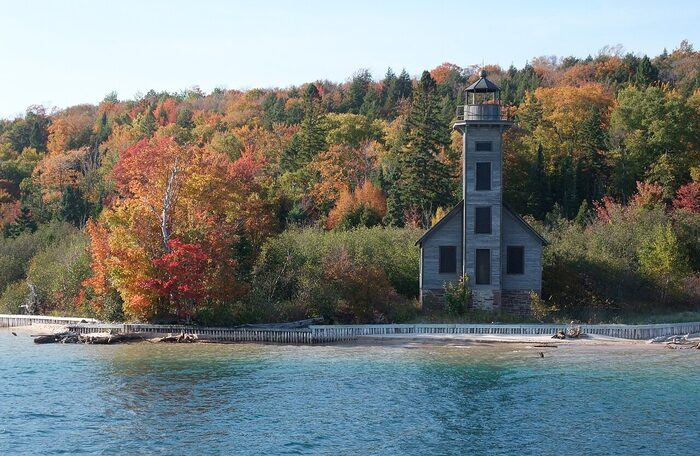 Grand Island East Channel Lighthouse from Lake Superior
VISITING INFORMATION
Street address: 400 East Munising Avenue
City, state, ZIP code: Munising, MI 49862
Telephone: (906) 387-2512
Official website: Grand Island National Recreation Area
Visitors reach Grand Island aboard a passenger ferry from Grand Island Landing, about 2½ miles west of downtown Munising. The short crossing to Williams Landing takes only about three to four minutes. There is a Visitor's Center on the island.
You can also kayak or boat over to the island, but it's not easy to land on. Explore the island primarily on foot or by bicycle. Bikes and kayaks can be rented at Williams Landing from the Grand Island Ferry Service.
The Grand Island Interpretive Bus, run by the ferry service, has a 2 1⁄2 - 3 hour narrated bus tour on the island. Passenger ferry service runs from late May through mid-October.
Reportedly a large mosquito and black fly army roams free on Grand Island, so bring protection. No supplies are available on the island, and there are no trash cans. Pack in and out everything you need.
Grand Island combines outdoor adventure, Lake Superior scenery and thousands of years of human history, making it a worthy addition to a central Upper Peninsula itinerary.
We send out a free newsletter now and then to keep you up to date on our website. Just put in your email and check the boxes below.
By Mike Miller, Copyright 2020-2026 YooperSecrets.com